
Keep preparation work out of billing
Filter, aggregate and prepare records before delivery to billing and other consumers. Combine real-time and file-based processing in one installation, with rules for each destination.
Pi MEDIATION / NETWORK DATA PROCESSING
Prepare diverse sources and formats for billing, analytics and new services in one processing layer. Reuse integrations across consumers and scale processing capacity with demand.
Pi Mediation is developed and supported by Tadam. Explore the Pi product family.
01 / WHY MEDIATION
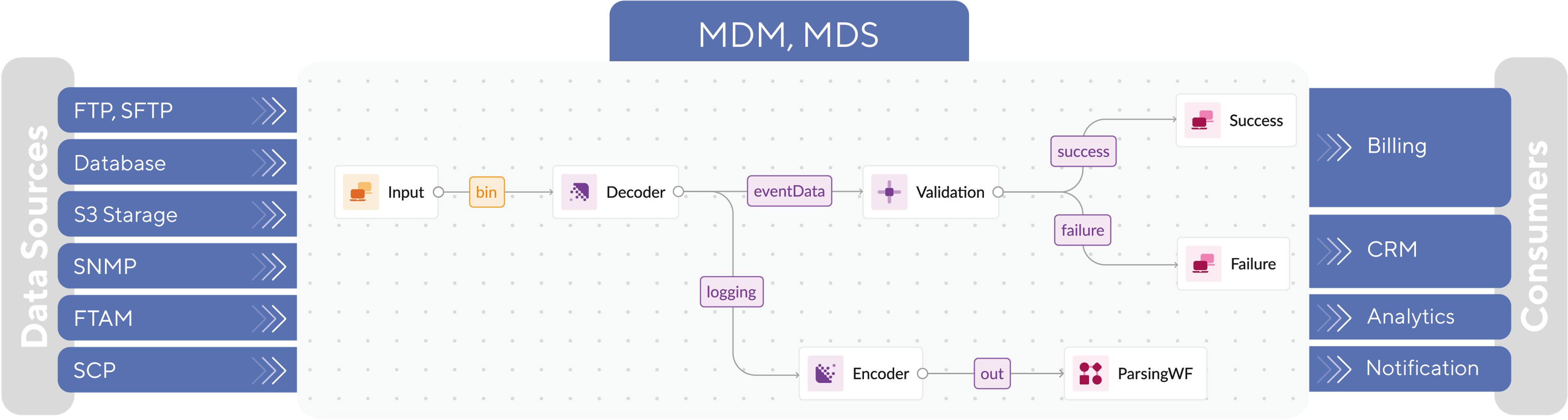
Each new source or downstream consumer can add another parser, script or billing-side workaround. Pi Mediation centralizes collection and common preparation, then applies the fields, formats and delivery rules each consumer needs.
Network elements, gateways, probes and files
Decode, validate, enrich, aggregate and deduplicate
Billing, warehouses, analytics and downstream systems
02 / WHAT YOU CAN DO
Filter, aggregate and prepare records before delivery to billing and other consumers. Combine real-time and file-based processing in one installation, with rules for each destination.
Decode ASN.1, CSV, XML, JSON, binary and text formats in visual workflows. Adapt validation, normalization and delivery rules as sources and business requirements change.
Enrich data using reference information, with caching and individual or bulk queries to external databases.
Use processing audits, live monitoring and alerts to investigate exceptions. Reprocess affected data after errors.
03 / BUILT TO BE OPERATED
Run a containerized, Kubernetes-based platform on your infrastructure, including on-premises. Execution workers are separate from administration and user access services.
Use automatic load balancing across processing workers. Plan active/active or active/standby geo-redundancy around your availability requirements.
Manage workflows through a web interface and automate configuration promotion between environments with CI/CD. Use role-based access and LDAP synchronization to organize team permissions.
IN PRACTICE / RESOURCES FOLLOW THE WORK
Traffic varies through the day, and a delayed source can deliver a backlog alongside live data. An elastic execution layer lets you respond to these changes instead of keeping peak processing capacity allocated throughout the day.
When overnight traffic falls, reduce processing workers and release cluster resources for other workloads.
Add execution capacity and distribute accumulated work across workers to accelerate processing.
As the queue clears, return to the capacity needed for ongoing traffic instead of retaining the peak allocation.
During a scoped pilot, compare processing rate, queue size and allocated resources. Agree scaling policies, recovery checks and source and destination limits against your service requirements.
04 / A CLOSER LOOK
Yes. Cloud-native describes the containerized, Kubernetes-based architecture; on-premises describes where it runs. Pi can run on the operator’s infrastructure. Cluster requirements, capacity and integration with existing operations are defined during deployment planning.
The result depends on how the workflow can distribute work and on source, storage and destination capacity. Scaling policies and resource limits are configured for the deployment and validated against the target workload.
On-premises, released capacity can serve other workloads on infrastructure you already own. A lower cloud bill depends on the billing model and whether paid resources are actually reduced; fewer processing workers alone do not guarantee lower charges.
No. Mediation prepares and delivers records. Rating, pricing and invoicing remain in the relevant business systems. The processing moved out of billing depends on the source records and accounting requirements.
Mediation can prepare inputs for traffic analysis, security analysis and predictive models when suitable source data and integrations are available. The receiving applications perform the analysis; those applications and models are not supplied by Mediation itself.
Tadam assesses your requirements, integrates Pi Mediation with your systems and prepares the solution for production. We support its integrations and configuration, with 8×5 or 24/7 coverage by agreement.
FZCO IFZA Business Park, DDP, Dubai, United Arab Emirates